Just sharing what has worked for me — this isn’t financial or legal advice. Fees and rates change over time, so always check Wise’s website or app for the latest.
Whether your clients are overseas, your kid is studying abroad, or you’re the one living out of a suitcase — the moment money crosses a border, Wise can usually save you a chunk of it. Here’s a quick, plain-English rundown of how it works and how I use it.
1. Why are traditional cross-border transfers slow and expensive?
Traditional wire transfers run on the SWIFT network. Your money hops through several intermediary banks, and each one shaves off a fee along the way. Worse, that total is a black box — you have no idea how much will actually land until it’s already gone.
2. How does Wise solve this?
Wise keeps local pools of money in most major countries. So when a client in the UK pays you, the money doesn’t actually fly across the Atlantic — Wise simply pays you an equivalent amount from its U.S. pool. The money never really “leaves the country,” there are no intermediary banks taking a cut, and transfers land almost instantly.
3. Wise vs. PayPal
- PayPal: a closed wallet. Both sides need an account, and withdrawing or converting money comes with steep rates.
- Wise: far more open. You get real local account details in multiple countries (a U.S. routing number, a UK Sort Code, a euro IBAN). When someone pays you, it feels like paying a local — at a tiny fraction of the cost.
4. The real killer feature: the mid-market rate
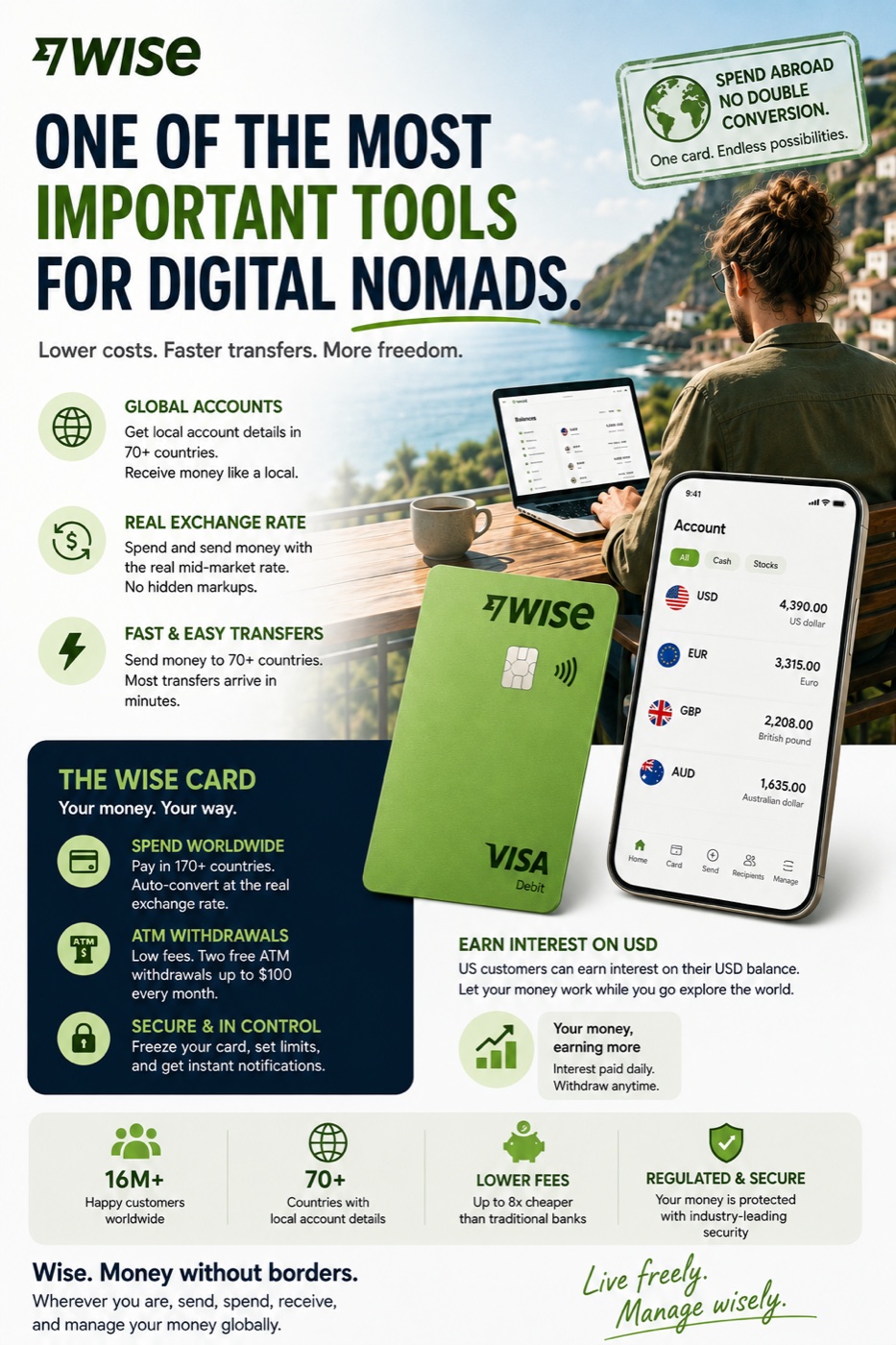
Banks and PayPal make most of their money on the exchange-rate spread, not the fee you can see. Wise uses the real mid-market rate — the exact one you’ll find on Google — and charges a single small, transparent fee, with no hidden markup.
The money-saving combo: receive money for free through local accounts, then convert it at a great rate with minimal loss. That’s why people call Wise a cheat code.
5. The debit card + earning on your USD
- Debit card: spending abroad and ATM withdrawals settle at the mid-market rate, so you’re not paying to convert twice.
- Earn on USD: U.S. users can choose to earn a yield on their USD balance, so money parked there in transit can pick up a little interest too (the current rate is whatever the app shows in real time).
6. Is it safe?
Wise is a regulated Money Services Business (MSB) in the U.S., and is regulated by the FCA and others in the UK — held to bank-level compliance standards. That said, I treat it as a tool for moving and spending money, not a place for large, long-term deposits.
7. Who is it for?
- Freelancers taking orders from overseas clients
- People living abroad long-term with U.S.-based income
- Small business owners juggling income across several countries
- Parents sending living costs or tuition to a child studying abroad (see the example below)
8. A real example: sending money to a child studying in the UK
Heads up: Wise only offers personal and business accounts — there is no family account. Parents and children each open their own separate Personal account.
Three steps:
- U.S. bank → your own Wise account (you top it up from an account in your own name — this is the one “same-name” rule to watch for).
- Convert USD to GBP inside the account (mid-market rate + a small, transparent fee).
- GBP balance → your child’s UK account (local clearing, free and near-instant; the recipient is your child, so the “same-name” rule doesn’t apply here).
Take $1,000 as an example: a traditional bank wire loses roughly $27–31, while going through Wise costs about $3–8 — cutting the loss from about 3% down to around 0.5%. On a big expense like tuition, that same ratio scales up to tens or even hundreds of dollars saved in a single transfer.
And this logic isn’t just for parents paying tuition. Whether you’re a freelancer invoicing European clients or a nomad with income scattered across several countries, it’s the same idea: let the money land in a local account first, then convert it at the real rate with minimal loss. Get this down, and your money moves around the world almost loss-free — like this father’s transfer — instead of quietly getting skimmed by a bank every time it crosses a border.
9. Getting started
(That’s my personal referral link — if you sign up through it, I may get a small bonus at no extra cost to you.)
More advanced tips — like little tricks for shaving down conversion costs — are coming later. Stay tuned.
Fees, interest rates, and other details can change over time — always go by the real-time figures on Wise’s website or in the app.
Leave a Reply